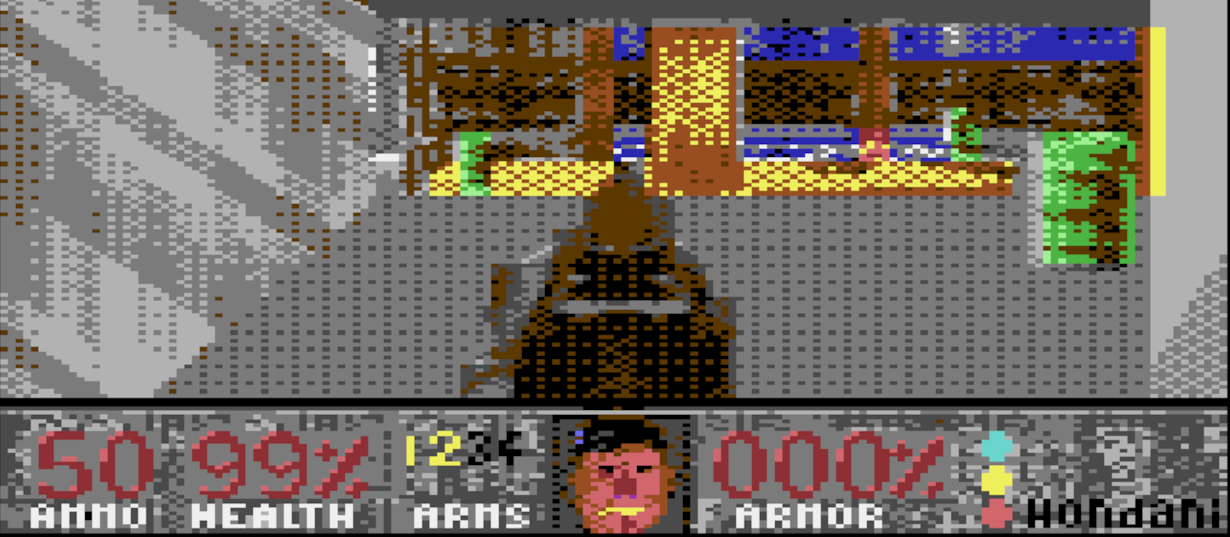
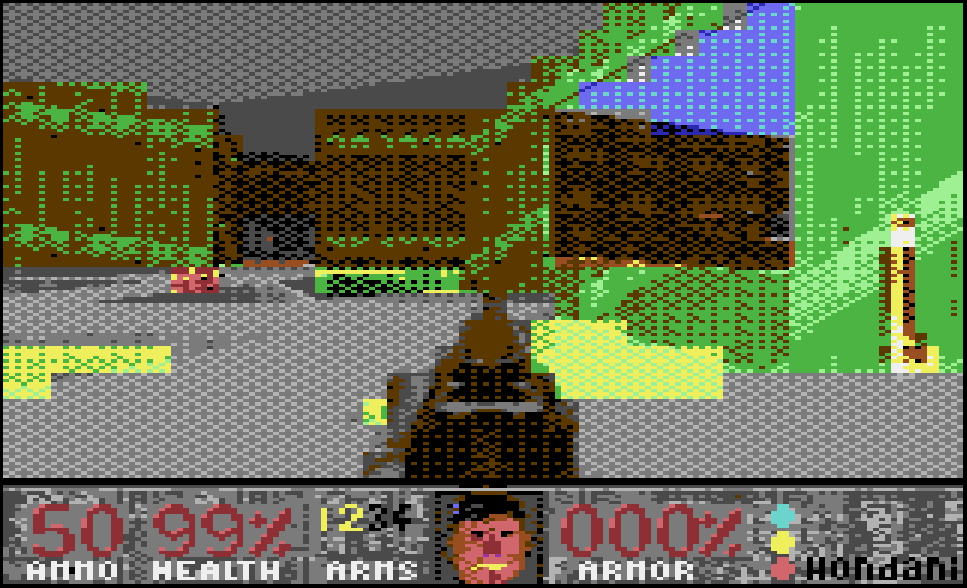
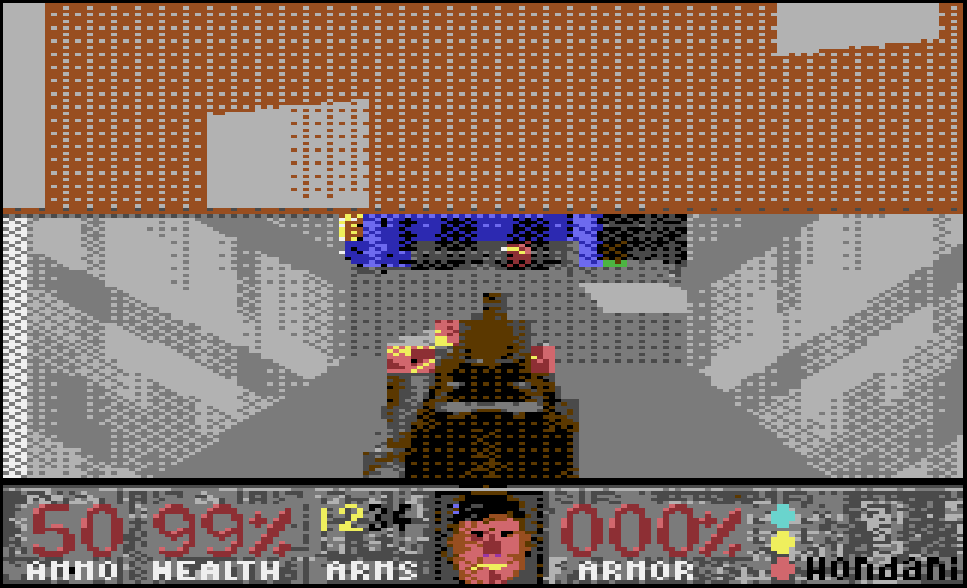
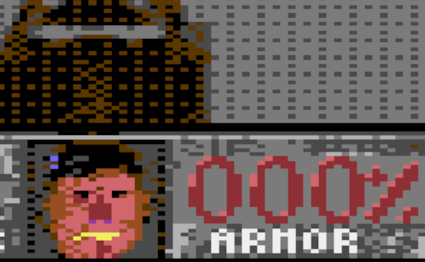
A BSP renderer built from scratch for the C64 Ultimate, walking id Software's real E1M1 map at a measured, locked frame rate on stock hardware — 64 KB of RAM, a 6510 at 64 MHz, and a 16 MB REU doing all the remembering. No id Software code. No emulation shortcuts. Open source.
Doom expects floating point, megabytes of fast random-access memory, and a CPU with headroom to spare. The C64 Ultimate offers none of that natively — a 6510 at up to 64 MHz, 64 KB of directly addressable RAM, and no FPU. What it does have is a 16 MB REU that can be treated as a real streaming asset store, and enough raw clock speed that a genuinely optimized 6502-style pipeline can hit a locked, playable frame rate.
Every optimization in this engine was verified pixel-for-pixel against the
previous version before being kept. The frame rate you see quoted here isn't a
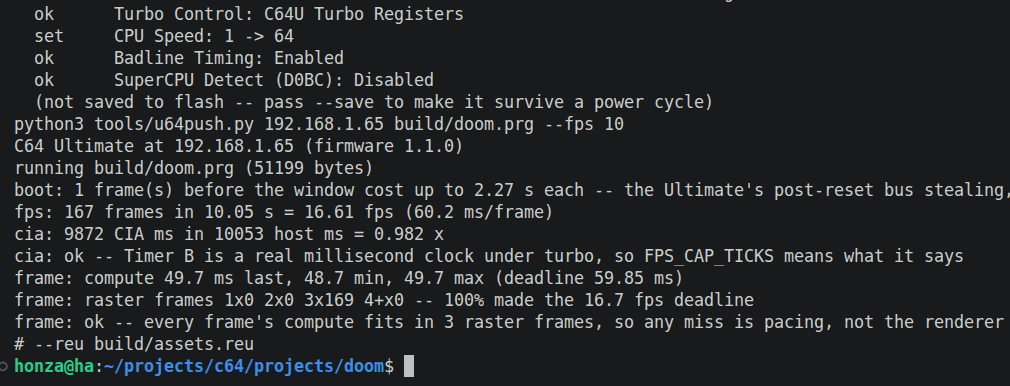
best-case emulator number — it's read off real hardware with make u64-fps,
averaged over hundreds of consecutive frames.
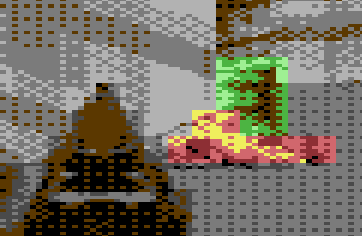
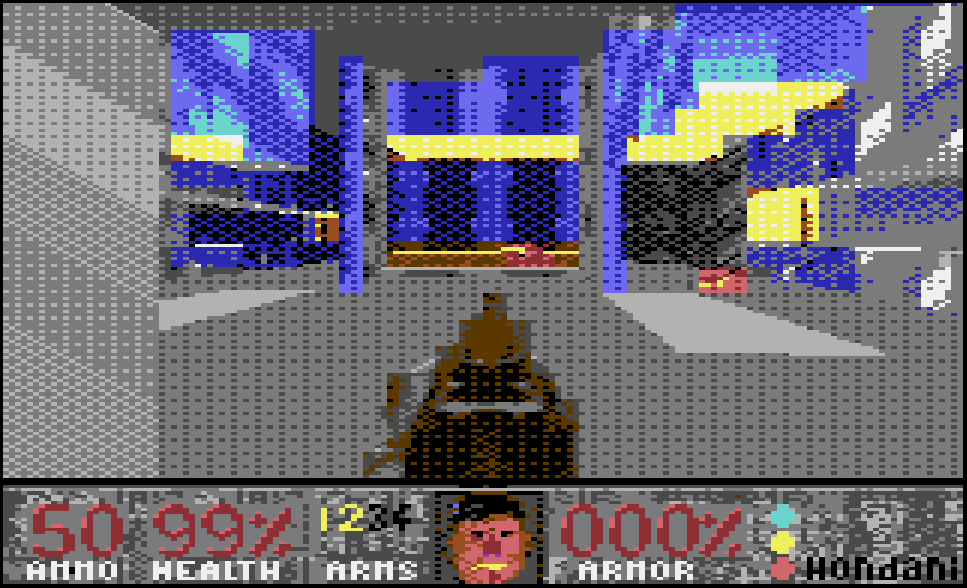
Captured straight off real hardware with HDN Shell, Hondani's other C64 Ultimate project.
Pre-built binaries are ready to run on your C64 Ultimate. Download from the latest release on GitHub, copy to your device, and follow the quick setup steps.
↓ Download from GitHub releasesgithub.com/slesinger/doom/releases/latestdoom folder in your C64 Ultimatedoom.cfg → RETURNgame.reu → RETURNlauncher.prg → RETURNThe pre-built binaries above include the assembled engine and pre-packed assets — no build tools needed to run.
Every frame moves through the same fixed pipeline. Nothing runs longer than the frame budget allows — the renderer is built to fail gracefully on complexity, not to blow the deadline.
Every frame you see is the result of these five stages executing within the 59.85 ms deadline. The chambers, textures, dithering, and sprite rendering happen in lockstep.
The C64U's 64 KB is the whole working set: code, the chunky framebuffer, HUD, and the small resident slice of level state the current subsector needs. Everything else — the BSP tree, segs, textures, sprites, music — lives in the 16 MB REU and is DMA'd in as the player moves, subsector by subsector.
The framebuffer (MATRIX, 160×176 chunky) alone is 28 KB —
45% of usable RAM. Almost everything else in the engine exists to keep the
per-pixel work over that single buffer inside the frame deadline.
The level's BSP tree, segs, textures and sprite images are pre-packed into a .reu image by a Python asset pipeline built for this project, then streamed into RAM subsector-by-subsector as the BSP traversal visits them — never the whole level at once. Music streams the same way but on its own clock: the score is packed as a SID register delta stream and DMA'd from REU tick-by-tick, driven by the CIA timer rather than the render loop, so it keeps playing at its own pace regardless of frame rate.
No FPU means no floats in the hot path. Projection, distance, and lighting terms all run in 16.16 fixed point, with reciprocal and trig terms pulled from precomputed tables rather than divided or computed per pixel.
Each surface's WAD light level and distance falloff pick an intensity on a shading ramp; the renderer draws that ramp into a chunky intermediate buffer, then converts to the VIC-II's multicolor bitmap mode with ordered (Bayer) dithering. Dithering is what turns the ramp's coarse intensity steps into a smooth-looking gradient within the VIC's fixed 3-colour-per-cell palette — the two stages are built to work together, not independently.
Frame times are read with make u64-fps on an actual C64 Ultimate — never an emulator's best case — and cross-checked against a raster-sync boundary that can only land on fixed multiples, so there's nowhere for an optimistic number to hide.
Walkable E1M1, flat-shaded, with music. The baseline proof that the pipeline works end-to-end on hardware.
| Frame rate | 25.05 fps |
| Deadline | 39.90 ms |
| Compute (measured) | 37.6 ms |
| Frames on deadline | 502 / 502 (100%) |
Textured walls, doors, moving sectors, jump, walk bob, sprites, weapon view, and a HUD land at a deliberately lower, more spacious frame rate to make room for all of it.
| Frame rate (locked) | 16.6 fps |
| Deadline | 59.85 ms |
| Compute (measured) | ~46–48 ms |
| Frames on deadline | 100% |
Illustrative proportions built from the measured figures in the project's implementation log, not a profiler screenshot — the underlying numbers are real, the segmentation is approximate.
Music isn't in this chart on purpose: it's driven by its own CIA timer interrupt, off the render loop's clock, so it doesn't spend any of the 59.85 ms render deadline — it plays at its own pace regardless of frame rate.
Every frame rate number on this site comes from real C64 Ultimate hardware, verified with make u64-fps and cross-checked against raster-sync boundaries.
Naive BSP traversal, no culling. Correct pixels, no budget discipline yet.
World-space seg backface test plus streamed bounding-sphere rejection of whole BSP subtrees before they're touched.
A frame cap plus an arithmetic pass worth roughly 9.4% closes the gap. Every step verified bit-identical: 0 of 104,448 pixels different from the reference render.
Nothing here is marked done until it's been measured on real hardware, not just in an emulator.
Walkable E1M1, flat-shaded, collision against real geometry, WASD + joystick, SID music from REU. 25.05 fps, 100% of frames on deadline.
Textured walls, doors & moving sectors, jumping, walk bob, HUD, sprites, and a weapon-view overlay — all shipped, fit into a locked 59.85 ms budget.
Enemies and combat, additional maps beyond E1M1, and a look at whether a fourth raster frame or resident (non-streamed) sprite assets buys back budget for the next round of features.
| Phase | Status |
|---|---|
| Textured walls | Shipped — measured 8.7 ms |
| Doors & moving sectors | Shipped — effectively free |
| Jump, walk bob | Shipped |
| HUD (health / armor / ammo) | Shipped — 0 ms measured, boot-only paint |
| Sprites & weapon view | Shipped — the last phase of M2 |
Enemies, projectiles, and the damage loop.
Loading custom, freely-distributable maps through the same REU-streaming pipeline — no dependency on any commercial WAD.
Resident downsampled sprites, or a fourth raster frame, to buy room for what M3 needs.
You're walking through id Software's real E1M1 map — same BSP geometry, same layout — but the rendering engine, collision, and audio playback are new code, built from scratch for the C64 Ultimate. It's a fan-made reinterpretation, not a port of id Software's engine or code.
Not yet. Right now it's E1M1 with textured walls, doors, sprites, a HUD, and a weapon view. Enemies, combat, and community map support are on the roadmap, tracked openly on GitHub.
To hit the measured frame rate, yes — the official Commodore C64 Ultimate (released 2025), not the older third-party "1541 Ultimate" cartridge; this project targets Commodore's hardware specifically and does not run on 1541 Ultimate devices. For development and testing without hardware, it also runs in the VICE emulator on any PC. The frame-rate numbers quoted on this site, though, are all measured on real Commodore C64 Ultimate hardware, not the emulator.
It isn't, really — the C64 Ultimate is a modern FPGA re-implementation of the C64 that can run the 6510 core at up to 64 MHz (vs. the original ~1 MHz) and pairs it with a 16 MB REU for fast external memory. This project is built specifically to exploit that: fixed-point math, REU as a real asset store, and a rendering pipeline designed around a hard frame deadline.
An earlier build reached 25 fps without textures or sprites. Adding textures, doors, and sprites at that same rate wasn't achievable without cutting one of them — so the engine deliberately targets a locked, stable 16.6 fps with more frame budget per feature, rather than a higher number that drops frames under load. Frame-time stability is treated as more important than peak FPS throughout this project.
Yes. The GitHub repo has the full implementation log, architecture notes, and open phases. Issues and discussions are the way in.
KickAssembler, Python 3, and a copy of DOOM1.WAD to generate the asset REU image — the free shareware/demo WAD is enough, or your own licensed copy of the full game. The engine doesn't ship id Software's data or code, and the repo doesn't ship the WAD either; wad2reu.py generates the REU image from a WAD file you provide locally.
This project is made by Hondani, a C64 scene group — Doom C64U is a Hondani production, credited to the group rather than any one contributor.
Hondani on CSDb →Full source, implementation log, and architecture docs. Issues and Discussions are open for questions, bug reports, and technical deep-dives.
Open repository →Full real-time E1M1 walkthrough on real C64 Ultimate hardware.
▶ Watch on YouTube →Technical writeups and release threads on CSDB.dk and Lemon64.com; cross-posts on r/commodore and r/retrogaming. Links go live at launch.
By Bobby Prince from Music From Doom Vol. 1. Extracted to PCM and replayed through the C64 Ultimate's audio sampler during the intro sequence.
By Thanos B. (DJ Space), 2025 — released by Hokuto Force. Played back on real SID hardware as a register stream from REU.
The intro screenshot shown on this project's launch screen is captured from id Software's original Doom (1993). In-game screenshots of the C64 Ultimate engine itself are captured directly from real hardware using HDN Shell.
Not an official Doom product. This project is licensed under CC BY-NC-SA 4.0 (Creative Commons Attribution-NonCommercial-ShareAlike).
"Doom" is a trademark of id Software / Bethesda Softworks. This project uses extracted geometry and bitmaps from Doom's E1M1 level as a derivative work and transformative fan project. The rendering engine is new code, written from scratch — it does not use id Software's original code. Building the level assets requires DOOM1.WAD (either the free shareware/demo WAD or a licensed copy you own), which you supply locally; no WAD data is redistributed by this repository.
Credits: Original Doom © id Software · C64U engine © Honza Slesinger, Hondani (2026) · Intro PCM by Bobby Prince · Gameplay music by Thanos B. (DJ Space) · Commodore 64 Ultimate hardware © Commodore
See LICENSE and ATTRIBUTION.md in the repository for complete licensing details.